Covert Hemorrhage and Response to Fluid
3 year old child. Wt 15 kg (33 lb), Ht 108 cm (42.5 in), BSA 0.67m2. Intraoperative. Laparotomy and resection of abdominal neuroblastoma. General anesthetic used and ventilated.
A good clear Doppler signal is defined by the tidy green line around the waveform, orange/white around waveform edge (more white along downslope) with a dark center and correct arrow placement. Gain was adequate.
At this point in surgery, CI, FTc and PV had reduced from previous results possibly indicating an increasing afterload, yet the urine output and BP remained stable.
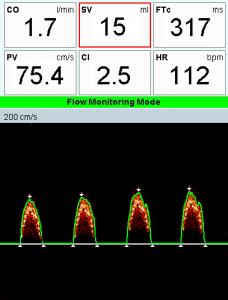
Whilst monitoring the child, 5 minutes later, the results continued to deteriorate, and blood was then seen in the suction canister. SV, FTc, PV and CO/I decrease suggesting further increase in afterload probably as a result of compensation to the drop in preload, together with an increase in HR. The waveform has also become smaller in height and width. BP at this point had also started to decrease. Fluid was given, Hb checked and a blood transfusion commenced.
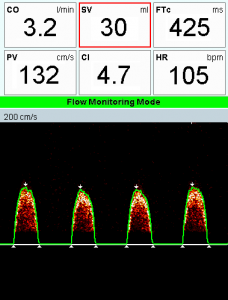
Half an hour later following fluid and blood, SV, FTc, PV and CO/I have increased as preload increased as well as a reduction in afterload. HR has also reduced and the waveform has increased in height and width.
Summary
In this scenario, the EDM+ indicated covert bleeding.
The EDM+ is the only technology precise enough to see small changes in flow. Flow is very responsive to changes in circulating blood volume, whereas pressure can often be maintained due to compensation. Hypovolemia is unlikely to be missed when flow is measured by the EDM+ because of its superior precision. Fluid can then be given safely in small amounts, thus preventing over or under filling of the patient.
Abbreviations: BP – blood pressure. BSA – body surface area. CO/I – cardiac output/index. CVP – central venous pressure FTc – flow time corrected. HR – heart rate. Ht – height. IV – intravenous. EDM+ – esophageal Doppler monitor. PV – peak velocity. SV/I – stroke volume/index. Wt – weight.